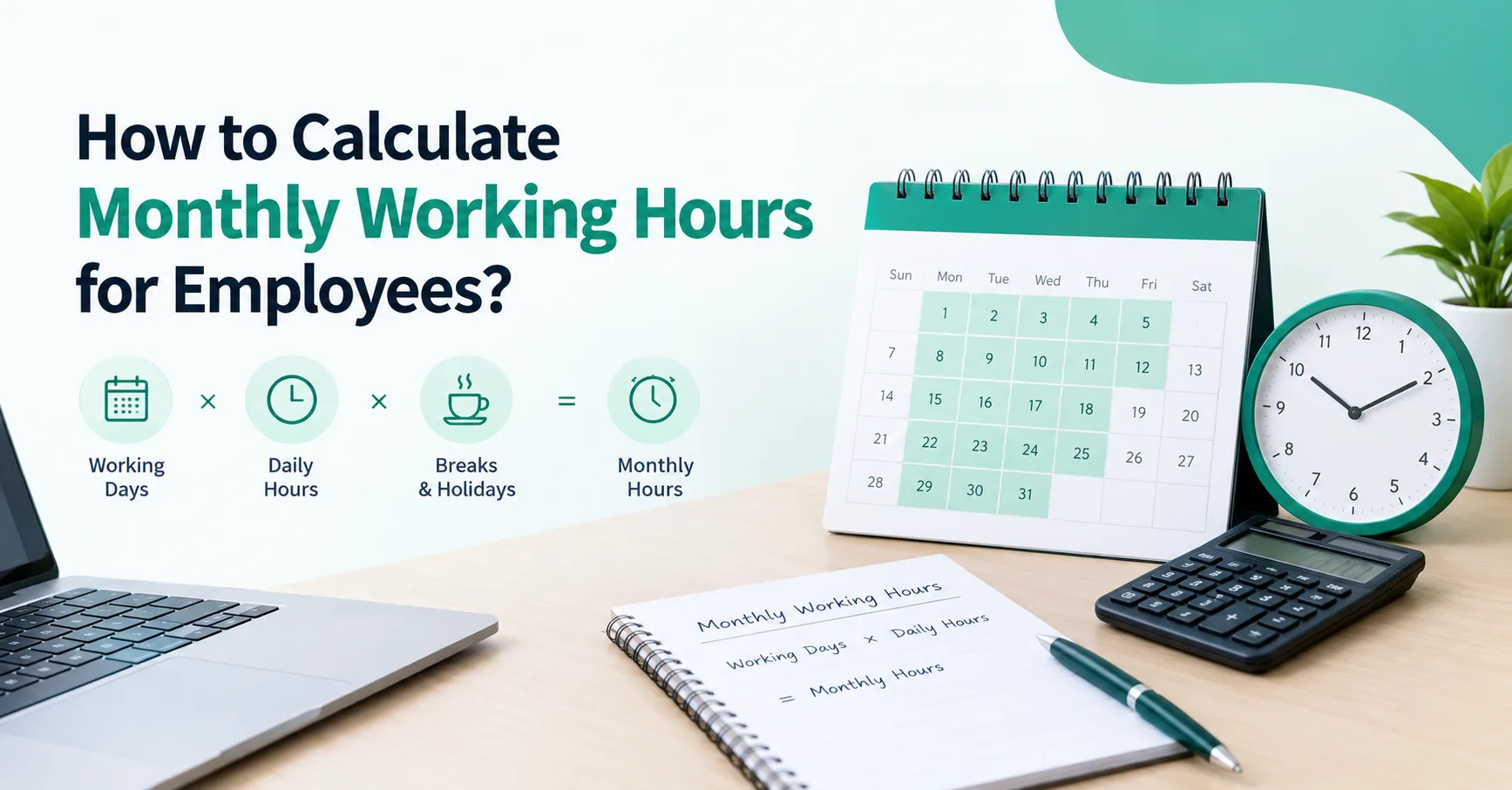
Determining monthly working hours is essential for businesses to manage employee schedules, track attendance, process payroll, and plan workloads. It gives employers a clear idea of how many hours an employee will work in a month. The total number of work hours for a month may, however, be affected by the number of working days, weekly hours, public holidays, and hours of work per day.
HR teams can simplify calculating employees' monthly working hours to keep accurate attendance records and ensure accurate payroll calculations.
Monthly Working Hours Definition
The Working Hours per Month are the total hours scheduled or expected to be worked by an employee in one month. This number of hours is typically based on the company's work schedule and the number of working days in that month.
For instance, an employee with 8 hours/day work schedule, working 5 days/week, is estimated to work 160 to 184 hours monthly based on the month's calendar.
Monthly working hours can be used for:
Computing salaries and hourly wages of employees.
Tracking attendance and overtime.
Managing employee workloads.
Preparing monthly timesheets.
Planning workforce schedules.
How many working hours does someone work each month?
Work hours can be computed in a month with a simple formula that relies on the number of working days and daily working hours.
Monthly Working Hours Formula
The basic formula is:
Monthly Working Hours = Days in month x Hours in a day.
For instance, if an employee has 22 working days in a month with an 8-hour workday, how many hours does he or she have to work in a month?
Monthly Working Hours = 22 × 8 = 176 hours.
So, the employee's weekly working time is 176 hours for the month.
Step-by-Step Calculation
Follow these steps to calculate monthly working hours accurately:
Step 1: Determine the number of working days
Count the total weekdays or scheduled working days in the month. Exclude weekly days off and applicable company holidays.
Step 2: Identify daily working hours
Check the employee's regular work schedule. For example, an employee may work 7.5, 8, or 9 hours per day.
Step 3: Multiply working days by daily hours
Multiply the total working days by the employee's daily working hours to determine the monthly total.
Step 4: Account for unpaid breaks
If unpaid meal breaks are excluded from working time, subtract them from the daily scheduled duration before calculating total working hours.
Factors That Affect Monthly Working Hours
The number of working hours may be affected by several reasons.
1. Days Off and Weekends
Typically, employees working a five-day schedule will have two days off, while those who work a six-day week will have one. This has an immediate effect on working hours for the month ahead.
2. Statutory and Company Holidays
Statutory and company holidays will affect the number of working days in a month, and should, therefore, be taken into account when calculating the number of working hours in a month.
3. Paid and Unpaid Breaks
When it comes to breaks, unpaid breaks are typically not included in working hours, whereas paid breaks might be included based on the employer's policies and local laws.
4. Additional Hours and Overtime
Employees may also be required to work additional hours beyond their regular schedule, and such hours should be accounted for separately on their attendance records to account for any overtime.
What are the ways Businesses can track Working Hours every Month?
Employee timesheets, attendance tracking, and HRMS software can help businesses keep track of employee hours during the entire month. This facilitates human resource departments in tracking attendance, generating accurate overtime logs, catching absences, and completing monthly reports.
Automated time tracking systems also minimize manual calculations and simplify the process of comparing the time allocated for tasks with the actual time spent on them.
Conclusion
To determine the monthly working hours, the number of working days, daily working hours, and relevant holiday/break days must be known. By using the proper formula, businesses can ensure that they have accurate attendance records, manage employee schedules, and process payroll efficiently. Frequently checking employee hours can also enable HR staff to detect inconsistencies and optimize employee management.
If you want to explore some more guides about HR, Management, Business, etc then visit Managetrix.com
Comments